
Why we are here
Looking for a copper porphyry
Most of the world’s copper comes from porphyry deposits. Finding one is a long shot, and it is the reason this project exists.
Most of the world’s copper
comes from porphyry deposits.
Large and long-lived
They are large, and they produce for decades.
Rare
There are not many of them, so finding one is a long shot.
The Yataga Intrusive Complex
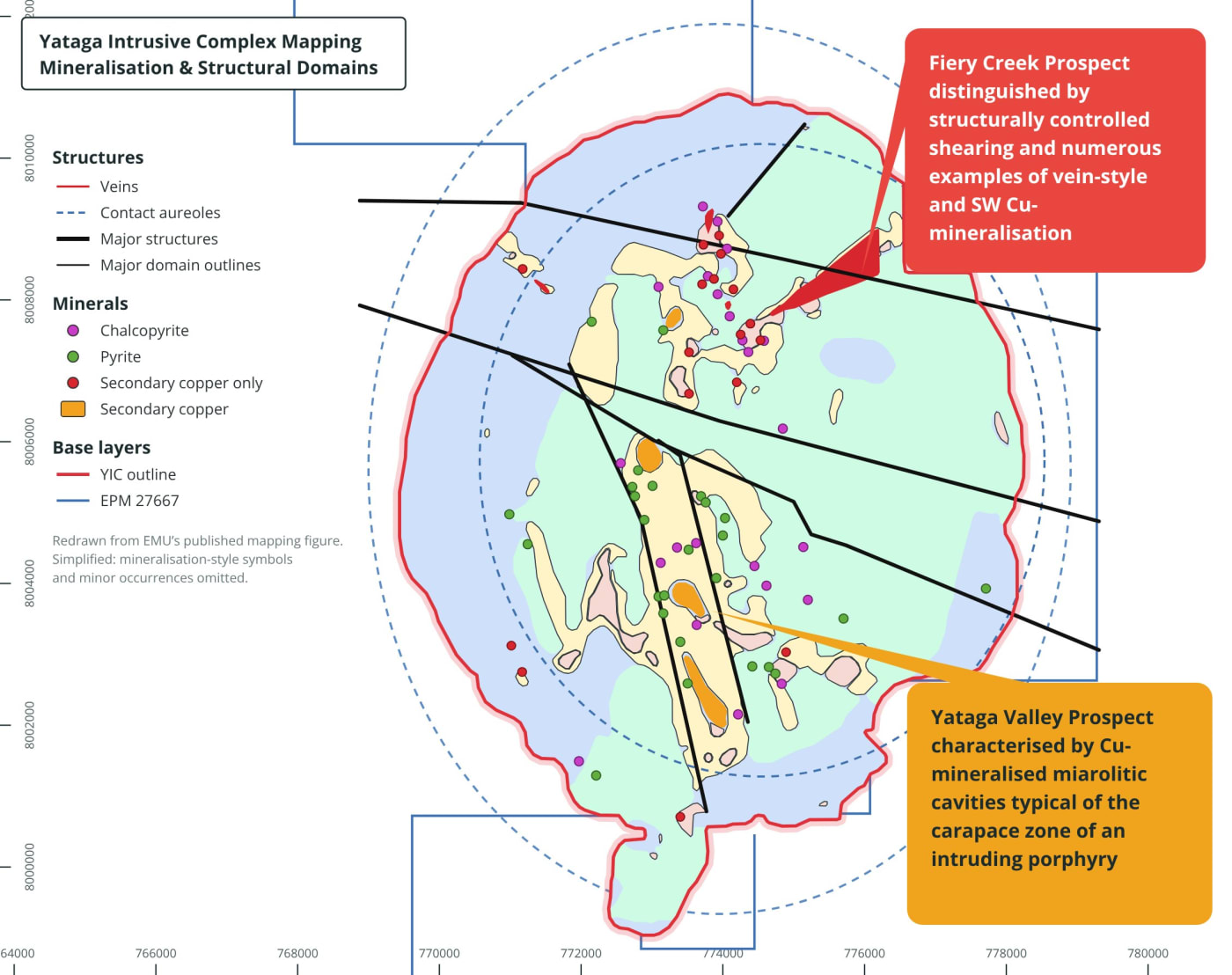
- 1About 70 km²A roughly circular intrusive body.
- 2Copper at surfaceShows over a wide area of the complex.
- 3Zonation points inward and downwardToward a source in the centre of the complex, rather than to something small and shallow that happens to outcrop.
- 4A Highland Valley-style settingOur consulting geologist, Dr Gregg Morrison, compares it to the Highland Valley complex in British Columbia, which hosts Canada’s largest open pit copper mine. A comparison of geological settings, not of what we have found.
Fiery Creek
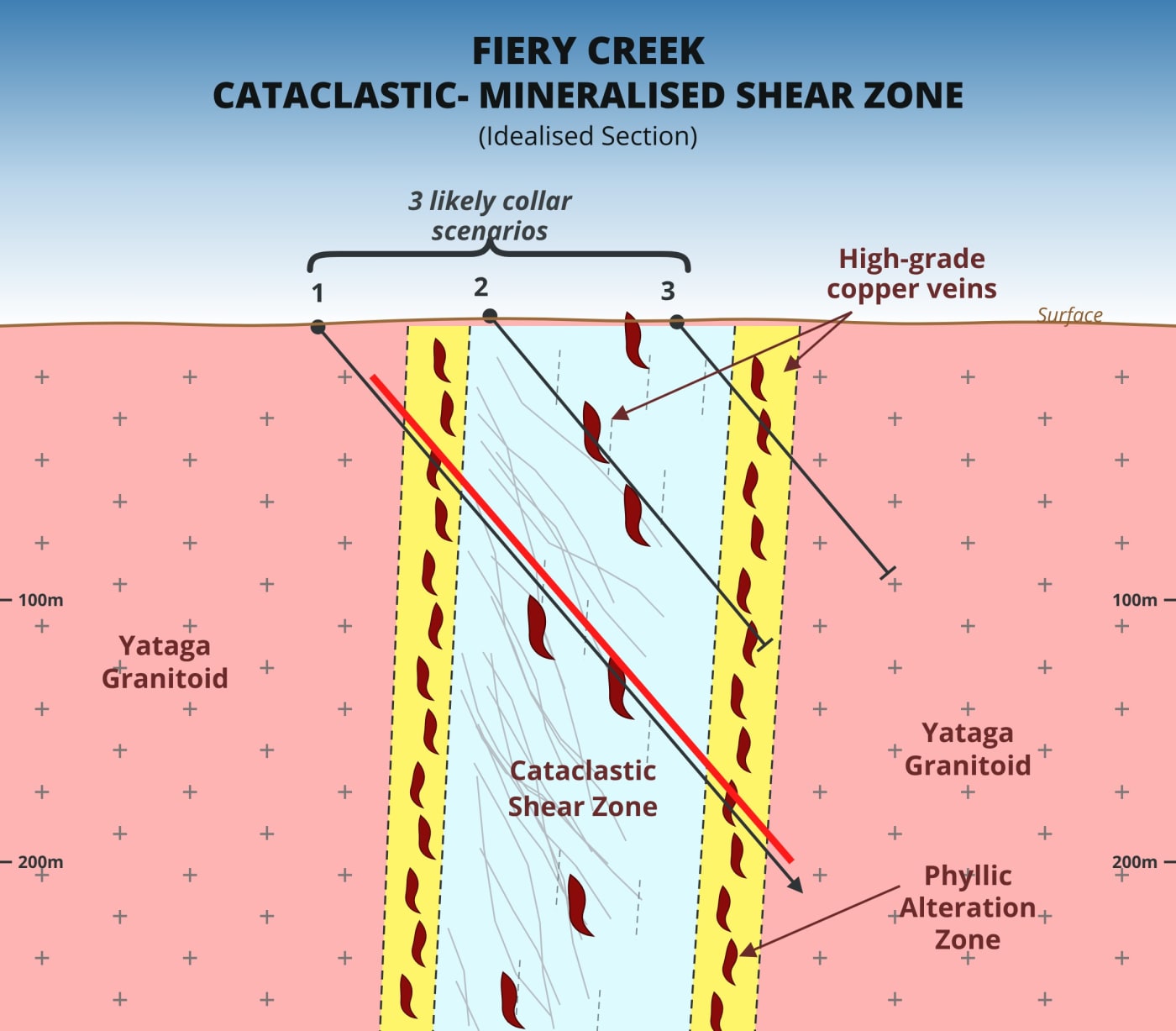
Fiery Creek is where the project started. Copper and silver outcrop here in shear zones, quartz veins and breccias, along a mapped corridor more than a kilometre long.
We drilled Fiery Creek first. It was the target we understood best, and what we learned from it would sharpen our targeting across the rest of the complex. That drilling confirmed a copper and silver system, both in the steep shear zone and in flatter intrusive related zones beneath it. Full results are in our ASX announcements.
Fiery Creek is not the prize on its own. It is evidence that the larger system is real.
Yataga Valley
Yataga Valley sits in the central part of the complex, and it is the larger of our two prospects. The Yataga Intrusive Complex hosts a surface copper–silver geochemical anomaly of approximately 8 x 3 km. Drilling, assays and surface mapping support key elements of a copper-bearing intrusive and hydrothermal system. Dr Gregg Morrison’s preliminary interpretation links the broad surface copper anomaly with elevated copper in the drilled rocks, while stronger values occur in structurally controlled, localised green veins and shears.
Some of the rock here carries disseminated copper filling small cavities. That is a texture you expect near the top of an intruding porphyry system rather than out at its edges, and it is part of why we think the source sits beneath this ground.
This is the target that matters most to us. We completed our first systematic drilling programme here in 2026, and the results are below.
Updated 17 November 2026
What our 2026 drilling found
17 RC holes, two of them extended with diamond tails, and three diamond holes drilled from surface. The final hole, 26YVDD020, was completed on 26 October 2026. Results so far are generally low in tenor, with stronger copper confined to localised intervals within structures and veins.
- 20holes drilled
- 4,650.70 mtotal drilling
- 2,940.40 mreverse circulation (RC)
- 1,710.30 mdiamond drilling
- 16 of 20holes completed, assays received
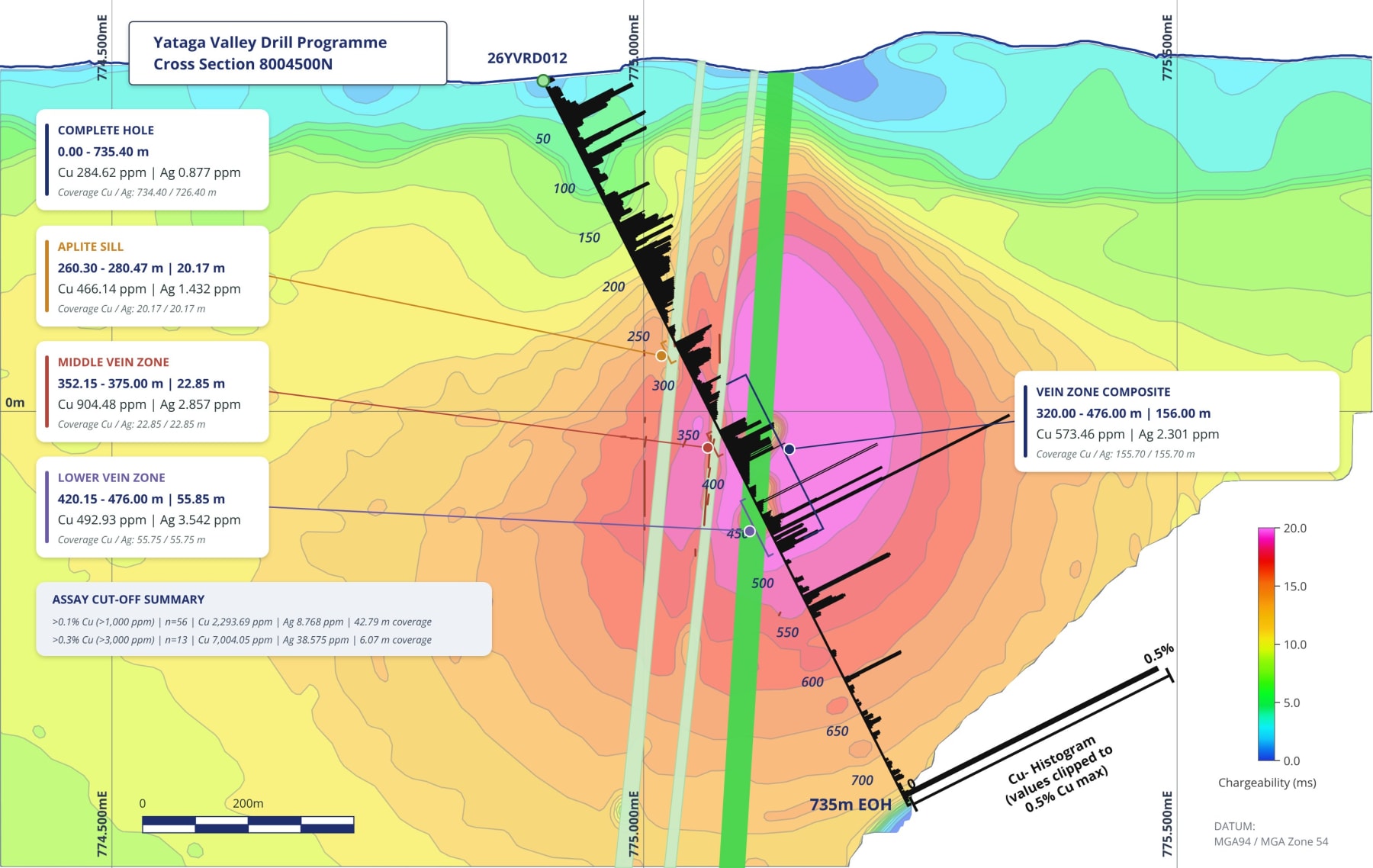
Hole 26YVRD012
Our deepest hole, drilled to 735.4 metres
Drilled to test a deep induced polarisation (IP) anomaly. Copper across the whole hole averaged almost 10 times the background value of copper in a granodiorite host rock. Scroll the log to follow it down.
Results so far are generally low in tenor. The Vein Zone envelope averages 573 ppm copper (about 0.057% Cu), with stronger copper in narrow veins.
| Zone | From to (m) | Length (m) | Cu | Ag (ppm) |
|---|---|---|---|---|
| Complete hole | 0.00 to 735.40 | 735.40 | 285.0 ppm | 0.9 |
| Broad geological envelope | 0.00 to 495.00 | 495.00 | 399.2 ppm | 1.2 |
| Vein Zone (envelope) | 320.00 to 476.00 | 156.00 | 573.5 ppm | 2.3 |
| Aplite Sill | 260.30 to 280.47 | 20.17 | 466.1 ppm | 1.4 |
| Middle Vein Zone | 352.15 to 375.00 | 22.85 | 904.5 ppm | 2.9 |
| Lower Vein Zone | 420.15 to 476.00 | 55.85 | 492.9 ppm | 3.5 |
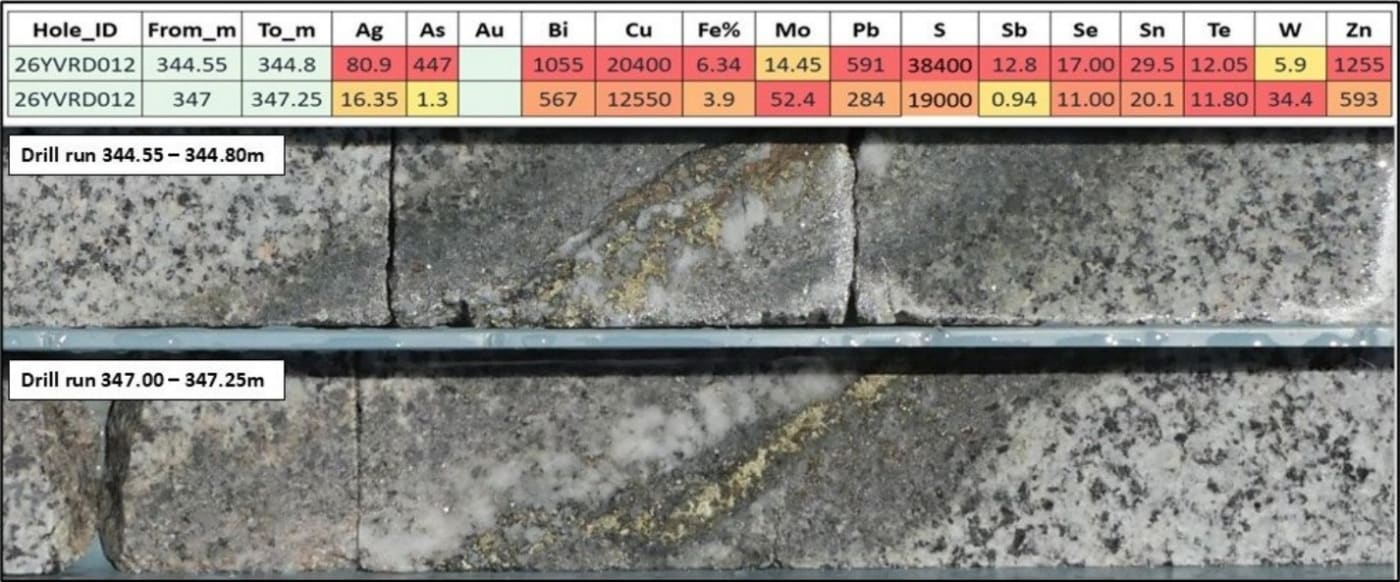
| Green Vein | 344.55 to 344.80 | 0.25 | 2.04% | 80.9 |
| Green Vein | 347.00 to 347.25 | 0.25 | 1.26% | 16.4 |
56 samples assayed at 0.1% Cu or more, and 14 at 0.3% Cu or more. Lengths are downhole and true widths are not yet known.
- Aplite Sill, 260.30 to 280.47 m, 466.1 ppm Cu
- Vein Zone envelope, 320 to 476 m, 573 ppm Cu (about 0.057%)
- Middle Vein Zone, 352.15 to 375.00 m, 904.5 ppm Cu
- Lower Vein Zone, 420.15 to 476.00 m, 492.9 ppm Cu
Assays received for the first 16 of the 20 holes completed. Complete results for the final 4 diamond holes (26YVRD015, 26YVDD018, 26YVDD019 and 26YVDD020; about 1,206 m in total) are pending, expected by the end of December 2026, subject to laboratory turnaround. The RC section of 26YVRD015 has been assayed; its diamond tail is pending.
2026 drilling
What we learned from 26YVRD012
The model holds up
Drilling, assays and mapping support key parts of our model: a copper-bearing intrusive and hydrothermal system.
Low tenor, with local highs
Results so far are generally low in tenor. Stronger copper values are confined to localised intervals within structures and veins.
The next question
Do these vein, breccia and structural settings host higher-grade zones with greater width and continuity?
Our consulting geologist, Dr Gregg Morrison, interprets the widespread low-tenor copper as helping to explain the broad surface anomaly.

“This year’s programme has improved our understanding of Yataga’s large copper-silver system and identified several areas for follow-up. Over the 2026-2027 wet season, we’ll integrate the geological observations and outstanding assays to plan follow-up mapping, sampling and target ranking. The results of that work will guide the design of the next drilling programme.”
| Zone | From to (m) | Length (m) | Cu | Ag (ppm) |
|---|---|---|---|---|
| Complete hole | 0.00 to 735.40 | 735.40 | 285.0 ppm | 0.9 |
| Broad geological envelope | 0.00 to 495.00 | 495.00 | 399.2 ppm | 1.2 |
| Vein Zone (envelope) | 320.00 to 476.00 | 156.00 | 573.5 ppm | 2.3 |
| Aplite Sill | 260.30 to 280.47 | 20.17 | 466.1 ppm | 1.4 |
| Middle Vein Zone | 352.15 to 375.00 | 22.85 | 904.5 ppm | 2.9 |
| Lower Vein Zone | 420.15 to 476.00 | 55.85 | 492.9 ppm | 3.5 |
| Green Vein | 344.55 to 344.80 | 0.25 | 2.04% | 80.9 |
| Green Vein | 347.00 to 347.25 | 0.25 | 1.26% | 16.4 |
56 samples assayed at 0.1% Cu or more, and 14 at 0.3% Cu or more. Lengths are downhole and true widths are not yet known.
- 26YVRC001Assays received
- 26YVRC002Assays received
- 26YVRC003Assays received
- 26YVRC004Assays received
- 26YVRC005Assays received
- 26YVRC006Assays received
- 26YVRC007Assays received
- 26YVRC008Assays received
- 26YVRC009Assays received
- 26YVRC010Assays received
- 26YVRC011Assays received
- 26YVRD012Assays received
- 26YVRC013Assays received
- 26YVRC014Assays received
- 26YVRD015Pending
- 26YVRC016Assays received
- 26YVRC017Assays received
- 26YVDD018Pending
- 26YVDD019Pending
- 26YVDD020Pending
Where we’re looking next
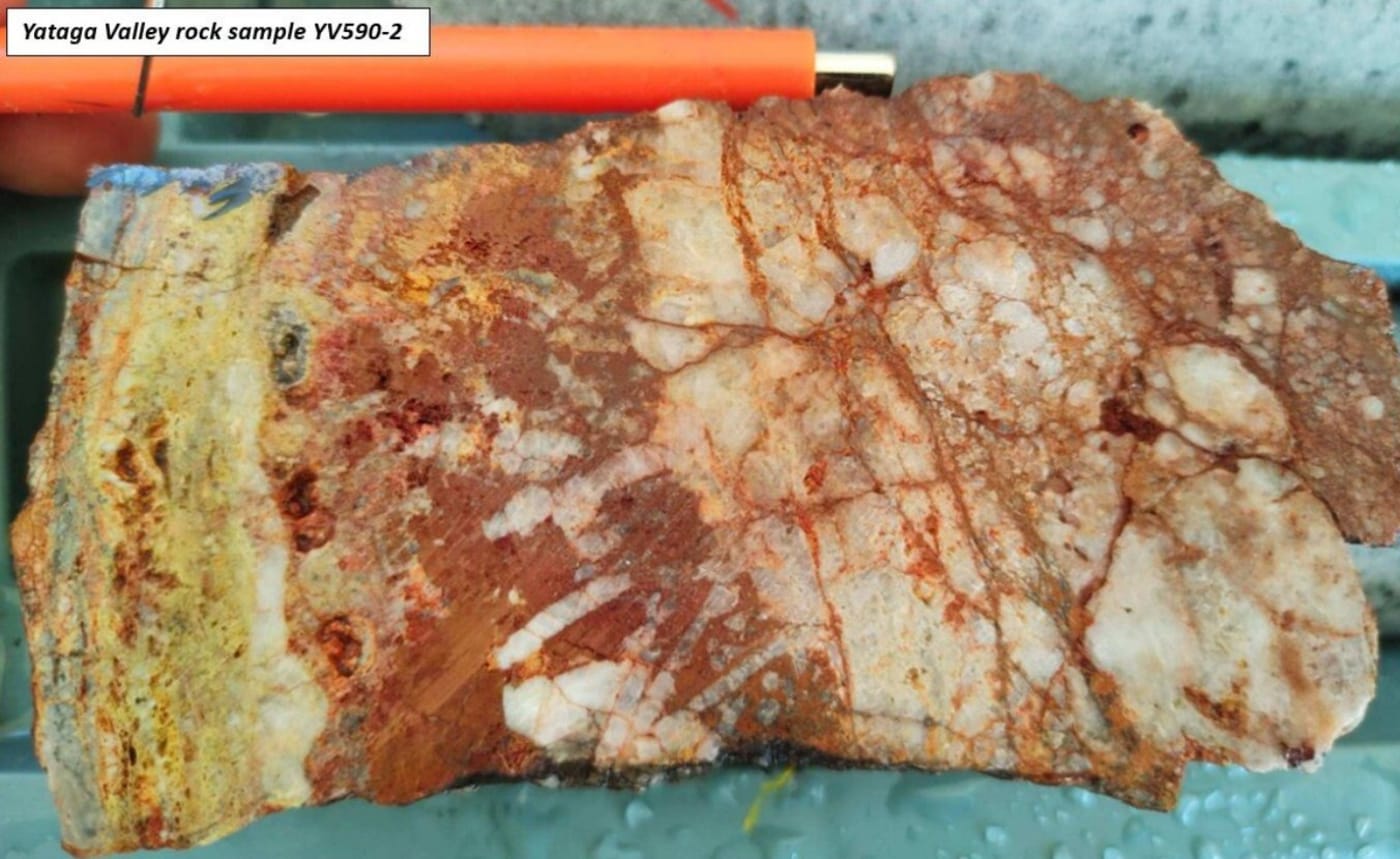
Our project-wide rock review identified more occurrences of gossan-bearing breccias and quartz veins than first recognised. We interpret these gossans as weathered expressions of former sulphides. Separately, surface mapping, rock sampling, drilling and assays have improved the basis for ranking copper-silver targets.
- Fiery CreekSamples with similar textures include some of the strongest copper and silver values in our reviewed sample set.
- Greisen HillGossan-bearing hydrothermal breccias and quartz veins identified for follow-up.
- Near 26YVRC008 and 26YVRC009At least four other locations with gossan-bearing breccias and quartz veins.
- Quartz lode west of 26YVRC008A major north-northwest trending quartz lode, interpreted as a possible continuation of the eastern bounding fault of Yataga Valley.
What happens next
- Late Nov 2026Complete the initial geological compilation and assess the controls on copper mineralisation.
- Nov to Dec 2026Continue the project-wide rock review and rank targets for follow-up in the 2027 field season. Field work for 2026 is complete.
- By end Dec 2026Complete results for the final 4 diamond holes (about 1,206m), subject to laboratory turnaround.
- Dec 2026 to Jan 2027Add the complete results for the final 4 diamond holes and refine our geological interpretation over the wet season.
- 2027 field programmeField follow-up at Fiery Creek, Greisen Hill and near 26YVRC008 and 26YVRC009, with detailed mapping, rock and soil sampling and target ranking, then design of the next drilling programme.
Copper and gold exploration also continues across our wider, approximately 850km² Georgetown project, where the gold prospects are early-stage.
Source. Information in this section is taken from our ASX announcement “Yataga Valley Drilling Advances, Next Exploration Targets” dated 17 November 2026. Read our ASX announcements.
Competent Person. The information in that announcement relating to Exploration Results is based on information compiled by Francisco Montes, a Member of the Australian Institute of Geoscientists, as set out in the announcement.